


Fun Drama - Watch Short Dramas
3.5158.00 Reviews
App Specs
- Version
- 2.6.5
- Updated On
- License
- Free
- Downloads
- 10,000,000+
- Developer
- Juliang Wuxian
- Categories
- Entertainment
- Platform
- Android, iOS
Screenshots
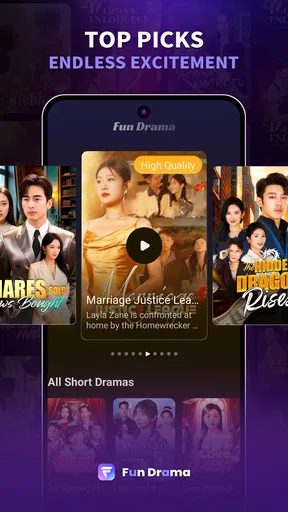





 Analysis by AppCompare
Fun Drama - Watch Short Dramas is the kind of entertainment app I open when I want a quick story rather than a full-length film. It focuses on short-form dramas that are easy to browse and watch in small pieces, which makes it a natural fit for a commute, a lunch break, or the few minutes before bed. I found the basic idea simple, but the real question is whether its viewing flow suits the way you like to consume fiction.
Developed by Juliang Wuxian, the app sits in the entertainment category and is free to install. It is aimed at Teen users, runs on Android 7.0 and later, and its current version is 2.6.5. The app has passed the ten-million-install mark, so it is not an obscure experiment with no audience. At the same time, its average rating of 3.5 from roughly twelve thousand ratings suggests a mixed experience: plenty of viewers find the format appealing, while others run into issues that are worth considering before making it part of your daily viewing routine.
How I use Fun Drama for short viewing sessions
My normal starting point is not to browse endlessly. I open the app with a specific amount of time in mind, then look for a drama that can give me a satisfying opening without demanding a long commitment. That approach works better here than treating the service like a traditional streaming platform. The appeal is not necessarily choosing one prestigious title and settling in for an evening. It is discovering compact stories and deciding quickly whether the next episode deserves a few more minutes.
The first useful habit is to judge a series by its opening rhythm rather than by its thumbnail alone. Short dramas often establish conflict quickly, so I give the beginning enough attention to see whether the characters and premise are clear. If the setup feels repetitive or overly rushed, I move on instead of spending a whole break hoping it improves. This makes the large amount of bite-sized content feel manageable rather than overwhelming.
A realistic everyday use case is a train ride with several short stops. I might begin one episode while waiting, pause when the train arrives, and continue later when I have another quiet moment. This is where the format has an advantage over a conventional movie: I do not have to protect a large block of free time. It also works for people who enjoy serialized fiction but rarely have the energy for a full television episode after work.
The trade-off is that short viewing can encourage automatic scrolling. One episode ends, another starts to look tempting, and suddenly the app has taken more time than planned. I recommend deciding in advance whether you are watching one episode, following one story, or simply sampling titles. That small boundary keeps the app useful for short breaks instead of turning every spare moment into an unplanned session.
Because the app is free, it is easy to try without making an immediate financial commitment. However, free access does not mean every part of the experience will feel equally frictionless. In-app purchases range from $0.99 to $15.99 per item, so I would pay attention whenever the viewing flow presents an option that asks for payment. If you only want casual sampling, keeping your usage exploratory is the safest approach. If you become invested in a particular drama, you should decide what you are comfortable spending before tapping through quickly.
Worth Reading Before You Choose

EA SPORTS FC Mobile 26 Is a Bigger Football Game, but It Takes Time

Flipboard Shows What News Apps Must Do Beyond the Feed

Switching to Android Auto Means Rethinking Your Driving Routine

Google Calendar Makes a Crowded Week Easier to Manage

Ludo King Makes the Most of the Minutes Between Plans

Baby Panda World Brings Quick Play to Modern Phones, but Its Game Library Feels Busy
Settings and viewing habits worth checking
I would begin by checking the app’s available playback and notification controls rather than assuming the default setup is ideal. The most useful settings are the ones that reduce interruptions: adjust notifications if they become distracting, and review any playback behavior that affects how episodes continue. I do not treat these as cosmetic details. In a short-drama app, an interruption at the wrong moment can be more annoying because each episode may depend on a quick emotional turn or a cliffhanger.
It is also worth checking how the app behaves when you leave a drama and return later. A repeatable routine helps: finish a natural stopping point, note the title you are following, and reopen that same story instead of beginning with a new recommendation every time. This matters because recommendation-driven browsing can make it difficult to remember what originally interested you. I found that a little personal organization makes the catalog feel more coherent.
For viewers who share a room or watch late at night, sound deserves practical attention. Keep the volume low enough to avoid sudden dialogue or music becoming disruptive, and use headphones when appropriate. Short dramas can move quickly between quiet conversation and heightened scenes, so a comfortable level is better than repeatedly reaching for the volume control. This is a simple habit, but it makes the app easier to use in public or around family members.
The Teen content rating is another reason to avoid handing the app to a younger child as if it were a general-purpose children’s service. Parents should make their own judgment about whether the available dramas fit their household. The rating does not tell me that every title has the same tone, so I would still preview content and pay attention to the themes in a series before recommending it to someone younger.
Compatibility is relatively broad on Android because the app supports version 7.0 and later. That helps users with older devices, although support for an operating system does not guarantee identical performance on every phone. If playback feels slow or the interface becomes uncomfortable on an older handset, I would first close other demanding apps, check available storage, and update the application when an update is offered. These are sensible maintenance steps, not a promise that every device will behave the same way.
Faster ways to find something worth watching
My quickest workflow is to separate discovery from viewing. During a spare moment, I browse enough to identify a few promising dramas. Later, when I genuinely want to watch, I choose from that small mental shortlist instead of starting the search from zero. This avoids wasting half a break on thumbnails and makes the app feel faster even when the catalog is large.
I also use a three-stage test. First, I look at the premise and visual presentation. Second, I watch enough to understand the central conflict. Third, I decide whether the next episode offers a meaningful reason to continue. If the only hook is a repeated cliffhanger with no character development, I stop. This is especially useful for viewers who enjoy dramatic twists but still want a story to build toward something.
Another effective pattern is to keep different expectations for different situations. When I have only a few minutes, I choose a familiar ongoing drama because I do not need to learn a new cast or premise. When I have more time, I sample something unfamiliar. Mixing these two modes prevents the app from becoming either too repetitive or too demanding. It also helps answer a common question: should you follow one series or browse many? For me, one main series plus occasional sampling provides the best balance.
Short-form viewing is not automatically better than conventional streaming. A service built around longer shows is usually a stronger choice when I want careful pacing, extended character arcs, consistent production style, or a story I can discuss in depth. Fun Drama is more suitable when convenience and immediacy matter most. It competes less with a movie night than with idle scrolling, short videos, and the habit of checking a phone whenever there is a pause in the day.
That comparison also explains why some users may be disappointed. If you expect every drama to have the polish, length, and narrative space of a premium television series, the compressed format can feel hurried. Scenes may prioritize the next reveal over subtle development. I see that as a central trade-off rather than a minor flaw. The app is at its best when I accept short drama as its own form instead of judging every title by the standards of a full-length production.
Where experienced use still meets limits
Good habits can make navigation and viewing more efficient, but they cannot solve every limitation. A disciplined workflow will not change the writing style of a series, the quality of its performances, or whether its pacing suits you. If several dramas fail to hold your attention, the issue may be the type of content rather than the way you are using the app.
The mixed average rating reflects that reality. An average of 3.5 is neither a clear warning nor a strong endorsement; it tells me to approach the app with realistic expectations. The audience is substantial, but popularity does not guarantee that every viewer will enjoy the catalog. I would try it for myself before paying for anything, especially if I am sensitive to repetitive plots, abrupt endings, or interruptions in a free viewing experience.
Payments require particular care because the app includes optional purchases. I would never tap through a prompt automatically while trying to reach the next episode. Instead, I would read what the purchase unlocks and decide whether that specific story is worth the cost. The range from $0.99 to $15.99 per item is wide enough that “just one small purchase” can mean different things depending on the item. Treating each transaction as a separate decision is a better habit than assuming all paid options are equivalent.
I would also avoid using the app as a replacement for every other form of entertainment. Its strongest quality is convenience, and convenience can become monotonous when used without variety. Pairing it with films, longer series, or non-screen activities keeps the short episodes enjoyable. In my experience, the app works best as a flexible layer in a viewing routine, not as the only place I look for stories.
For someone deciding whether to install it, the key questions are practical. Do you enjoy serialized drama in very small portions? Are you comfortable exploring a free app that offers optional purchases? Can you stop browsing when you have reached the end of your planned break? If the answers are yes, Fun Drama has a clear use case. If you want a carefully curated premium catalog, uninterrupted long-form viewing, or content selected for children, I would choose a different kind of service.
My verdict after building a repeatable routine
Fun Drama is most convincing as a quick, low-commitment way to sample serialized stories. I like that it fits around ordinary gaps in the day, and I appreciate the freedom to test a premise without reserving an entire evening. The free entry point makes experimentation easy, while the Teen rating gives adults a useful reminder to consider the tone of individual dramas before sharing the app with younger viewers.
My recommendation is to use it deliberately. Check the available controls, reduce distractions, choose a viewing limit, and keep track of the drama you actually want to follow. Those habits do more for the experience than endless browsing. They also make it easier to notice whether the app’s storytelling style genuinely suits you before you spend money on an optional item.
I would recommend Fun Drama - Watch Short Dramas to viewers who want fast emotional hooks, flexible sessions, and a steady stream of compact fiction on an Android device. I would be more cautious with anyone seeking refined long-form storytelling or a completely predictable, premium-style viewing experience. The app has enough reach to be worth trying, but its 3.5 average rating is a fair reminder to explore first and purchase later.
Ultimately, Fun Drama - Watch Short Dramas succeeds when I treat it as a pocket-sized drama shelf rather than a universal streaming replacement. Its best moments arrive when I have a short break, a clear idea of what I want, and the patience to stop when a story no longer earns my attention. Used that way, it is a convenient entertainment option with a recognizable purpose, even if its compressed format and optional purchases will not suit everyone.
Pros
- Short episodes fit easily into quick breaks.
- Large selection of romance
- mystery
- and family stories.
- Simple interface makes browsing and playback easy.
- Frequent new episodes keep the catalog feeling fresh.
- Personalized recommendations help discover similar dramas.
Cons
- Many episodes require coins or a premium subscription.
- Ads can interrupt viewing
- especially for free users.
- Some story translations may feel awkward or inconsistent.
- Episodes often end on cliffhangers that encourage continued watching.
- Video quality and loading speed may vary by network.
FAQs for Fun Drama - Watch Short Dramas
What is Fun Drama - Watch Short Dramas?
Fun Drama - Watch Short Dramas is a mobile streaming app focused on short-form drama series. It offers bite-sized episodes designed for quick viewing, with stories commonly featuring romance, family conflicts, suspense, and unexpected twists. The app is aimed at users who prefer watching serialized content in short sessions rather than committing to full-length television episodes or movies.
Is Fun Drama - Watch Short Dramas free to download and use?
The application can generally be downloaded without an upfront charge, but access to all content may depend on the app’s monetization model. Some episodes or features can be available for free, while other chapters may require watching advertisements, using in-app currency, subscribing, or making individual purchases. Check the current pricing and payment details in the official store before downloading.
Does Fun Drama require an internet connection?
Yes, an internet connection is normally required to browse the drama catalog and stream episodes. Playback quality may vary depending on your Wi-Fi or mobile data connection, and watching many episodes over cellular data could use a significant amount of your allowance. If the app provides offline viewing, availability may be limited to selected content or premium users, so confirm this inside the app.
What kind of dramas and languages are available?
The catalog is primarily built around short, fast-paced dramatic stories, often organized into multiple brief episodes that end with cliffhangers. Available genres may include romance, revenge, family drama, mystery, and relationship stories. Language options, subtitles, dubbing, and the size of the catalog can change over time, so users should review the title information and supported language settings before watching.
Are there advertisements or in-app purchases in Fun Drama?
Users should expect that the app may include advertising and optional in-app purchases. Advertisements can be used to unlock episodes or continue watching, while premium access or virtual coins may provide faster access to restricted chapters. Because prices, offers, and unlocking requirements can vary by region and change through updates, review the purchase screen carefully and enable parental controls if children may use the app.


